
Share Share by:
- Copy link
- X
Share this article Join the conversation Follow us Add us as a preferred source on Google
A fully 3D-printed quadcopter has gained the title of the world’s fastest drone by reaching a top speed of 659 kilometers per hour (408 mph) with tailwind. Built and piloted by engineer and YouTuber Luke Maximo Bell along with his father, the Peregreen V4 officially recorded a two-run average of 657 kmph under Guinness verification. The drone additionally managed to reach an upwind speed of 599 kmph, which is said to be an improvement of 14 kmph over its predecessor.
With this achievement, the father-son duo once again claimed the speed title after their previous attempt was overtaken by Australian aerospace engineer Ben Biggs, who set a 626 kmph (389 mph) record with his Blackbird drone.
The project took over two years to engineer and involved computational fluid dynamics (CFD) modeling, rapid prototyping, and iterative flight testing to refine aerodynamics. The entire body of the Peregreen V4 was made using the Bambu Lab H2D 3D printer with multiple materials including PETG, PA6-CF, and TPU. “The new printer’s larger build volume and dual-nozzle system made it possible to print the body as one continuous piece. That gave us smoother aerodynamics and a much higher surface finish quality than before” said Luke in his YouTube video. The use of 3D printing also allowed the team to fine-tune mechanical flexibility, heat resistance, and aerodynamic integrity without relying on any external fabrication.
You may like
-
![]() Dronemaker DJI buys into 3D printer manufacturer Elegoo — move seen as way to diversify away from drones amid worries of U.S. ban
Dronemaker DJI buys into 3D printer manufacturer Elegoo — move seen as way to diversify away from drones amid worries of U.S. ban -
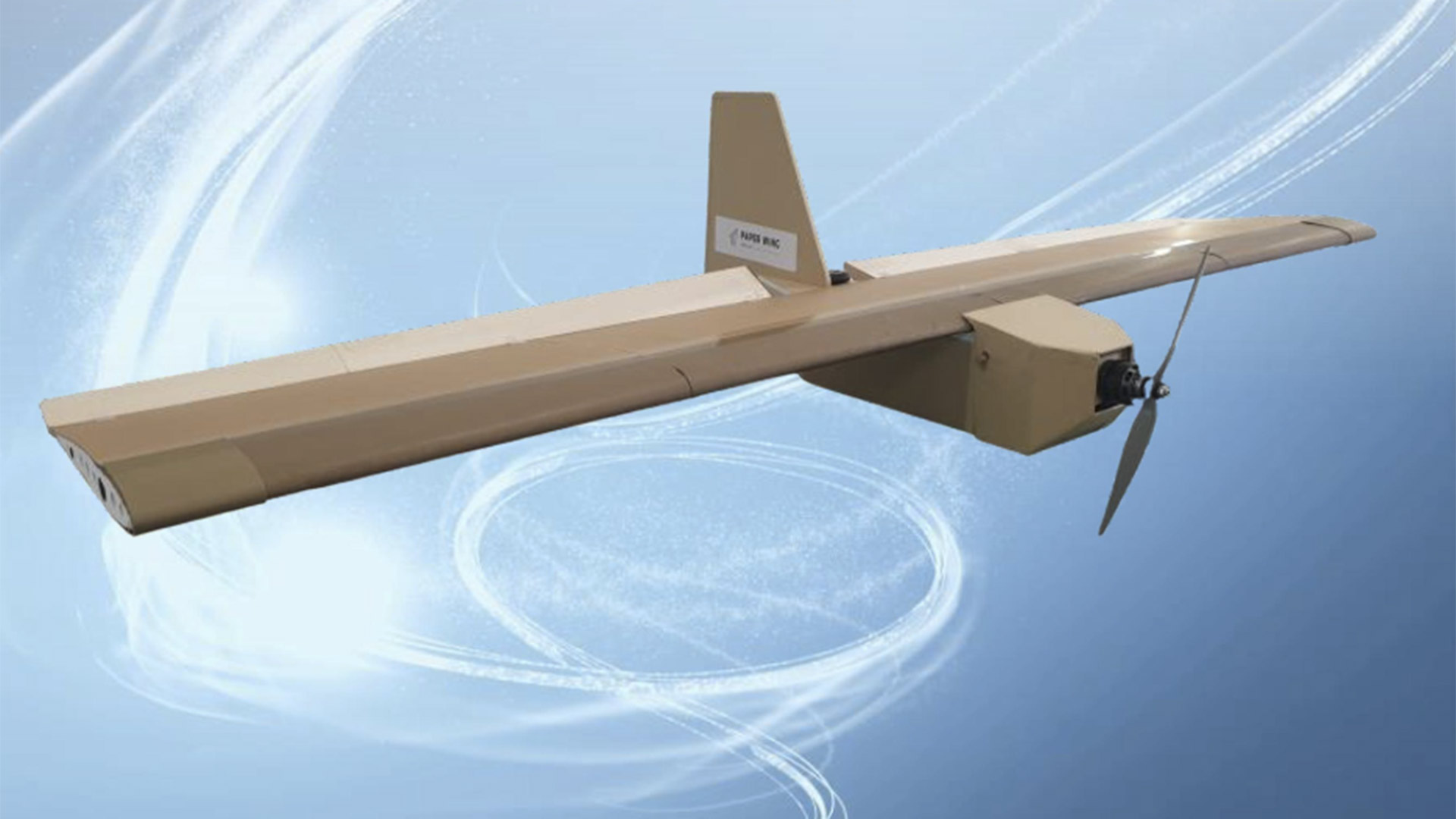 Korea’s cardboard drones address UAV shortages and climate crisis
 -
![]() Anycubic promises its Kobra X high-speed multi-filament printer can print over twice as fast and with half the material at $259
Anycubic promises its Kobra X high-speed multi-filament printer can print over twice as fast and with half the material at $259
As for the motors, Luke went ahead with three options – the AOS Supernova, AMX 2826, and T-Motor 3120. These motors were first tested to gather live thrust readings using strain gauges along with an amplifier and Arduino board. After some rigorous flight testing, the team went with the T-Motor 3120 as it offered better reliability in terms of temperatures along with zero scrapping. The team also ended increasing the motor windings from 800 KV to 900 KV for higher RPM and a faster top speed.